
Linux top命令输出中PR值和NI值有什么不同
NI 是优先值,是用户层面的概念, PR是进程的实际优先级, 是给内核(kernel)看(用)的。
一般情况下,PR=NI+20, 如果一个进程的优先级PR是20, 那么它的NI(nice)值就是20-20=0。
NI is the nice value, which is a user-space concept. PR is the process’s actual priority, as viewed by the Linux kernel.
For normal processes, the kernel priority is simply +20 from the nice value. Thus a process with the neutral nice value of zero has a kernel priority of 20. This offset-by-20 is done so that a process with a nice value of -20, the highest priority nice value, receives a kernel priority of zero. Lower numeric values equal higher scheduling priority.
For realtime processes, the kernel priority is the process’s real-time priority, but thePR column will simply print RT.
In some versions of the Linux kernel, the kernel priority could differ from the nice value, as the process scheduler applied a small bonus or punishment to interactive or processor-hogging tasks, respectively. In these older kernels, the value given by the PR column could differ from the nice value. This isn’t true with the kernel’s current scheduler, the Completely Fair Scheduler (CFS).
This article come from:
http://www.quora.com/Linux/What-is-the-difference-between-the-NI-and-PR-values-in-the-top-1-commands-output
XAMPP php版本历史
XAMPP版本历史如图
http://code.stephenmorley.org/articles/xampp-version-history-apache-mysql-php/
XAMPP Apache MySQL PHP 5 PHP 4
1.8.1 2.4.3 5.5.27 5.4.7
1.8.0 2.4.2 5.5.25a 5.4.4
1.7.7 2.2.21 5.5.16 5.3.8
1.7.5 2.2.21 5.5.15 5.3.8
1.7.4 2.2.17 5.5.8 5.3.5
1.7.3 2.2.14 5.1.41 5.3.1
1.7.2 2.2.12 5.1.37 5.3.0
1.7.1 2.2.11 5.1.33 5.2.9
1.7.0 2.2.11 5.1.30 5.2.8
1.6.8 2.2.9 5.0.67 5.2.6 4.4.9
1.6.7 2.2.9 5.0.51b 5.2.6 4.4.8
1.6.6a 2.2.8 5.0.51a 5.2.5 4.4.8
1.6.6 2.2.8 5.0.51 5.2.5 4.4.8 (RC2)
1.6.5 2.2.6 5.0.51 5.2.5 4.4.7
1.6.4 2.2.6 5.0.45 5.2.4 4.4.7
1.6.3a 2.2.4 5.0.45 5.2.3 4.4.7
1.6.3 2.2.4 5.0.54 5.2.3 4.4.7
1.6.2 2.2.4 5.0.41 5.2.2 4.4.7
1.6.1 2.2.4 5.0.37 5.2.1 4.4.6
1.6.0a 2.2.4 5.0.33 5.2.1 4.4.5
1.6.0 2.2.3 5.0.33 5.2.1 4.4.5
centos 6.2 更新报错解决 yum you could try using skip broken to work around the problem
centos 6.2 更新报错解决 yum you could try using skip broken to work around the problem
yum update
Loaded plugins: aliases, changelog, downloadonly, kabi, presto, refresh-
: packagekit, security, tmprepo, verify, versionlock
Loading support for Red Hat kernel ABI
adobe-linux-x86_64 | 951 B 00:00
google-chrome | 951 B 00:00 …
sl | 3.2 kB 00:00
sl-security | 1.9 kB 00:00
Setting up Update Process
Resolving Dependencies
–> Running transaction check
—> Package python-qpid.noarch 0:0.12-1.el6 will be updated
—> Package python-qpid.noarch 0:0.14-11.el6_3 will be an update
—> Package python-qpid-qmf.x86_64 0:0.12-6.el6 will be updated
—> Package python-qpid-qmf.x86_64 0:0.14-14.el6_3 will be an update
—> Package qpid-cpp-client.x86_64 0:0.12-6.el6 will be updated
–> Processing Dependency: libqpidclient.so.5()(64bit) for package: matahari-agent-lib-0.4.4-11.el6.x86_64
–> Processing Dependency: libqpidclient.so.5()(64bit) for package: matahari-network-0.4.4-11.el6.x86_64
–> Processing Dependency: libqpidclient.so.5()(64bit) for package: matahari-sysconfig-0.4.4-11.el6.x86_64
–> Processing Dependency: libqpidclient.so.5()(64bit) for package: matahari-service-0.4.4-11.el6.x86_64
–> Processing Dependency: libqpidclient.so.5()(64bit) for package: matahari-host-0.4.4-11.el6.x86_64
–> Processing Dependency: libqpidcommon.so.5()(64bit) for package: matahari-network-0.4.4-11.el6.x86_64
–> Processing Dependency: libqpidcommon.so.5()(64bit) for package: matahari-host-0.4.4-11.el6.x86_64
–> Processing Dependency: libqpidcommon.so.5()(64bit) for package: matahari-sysconfig-0.4.4-11.el6.x86_64
–> Processing Dependency: libqpidcommon.so.5()(64bit) for package: libvirt-qmf-0.3.0-4.el6.x86_64
–> Processing Dependency: libqpidcommon.so.5()(64bit) for package: matahari-agent-lib-0.4.4-11.el6.x86_64
–> Processing Dependency: libqpidcommon.so.5()(64bit) for package: matahari-service-0.4.4-11.el6.x86_64
—> Package qpid-cpp-client.x86_64 0:0.14-22.el6_3 will be an update
—> Package qpid-cpp-client-ssl.x86_64 0:0.12-6.el6 will be updated
—> Package qpid-cpp-client-ssl.x86_64 0:0.14-22.el6_3 will be an update
—> Package qpid-cpp-server.x86_64 0:0.12-6.el6 will be updated
—> Package qpid-cpp-server.x86_64 0:0.14-22.el6_3 will be an update
—> Package qpid-cpp-server-ssl.x86_64 0:0.12-6.el6 will be updated
—> Package qpid-cpp-server-ssl.x86_64 0:0.14-22.el6_3 will be an update
—> Package qpid-qmf.x86_64 0:0.12-6.el6 will be updated
—> Package qpid-qmf.x86_64 0:0.14-14.el6_3 will be an update
—> Package qpid-tools.noarch 0:0.12-2.el6 will be updated
—> Package qpid-tools.noarch 0:0.14-6.el6_3 will be an update
—> Package ruby-qpid-qmf.x86_64 0:0.12-6.el6 will be updated
—> Package ruby-qpid-qmf.x86_64 0:0.14-14.el6_3 will be an update
–> Finished Dependency Resolution
Error: Package: matahari-host-0.4.4-11.el6.x86_64 (@anaconda-ScientificLinux-201202061444.x86_64)
Requires: libqpidclient.so.5()(64bit)
Removing: qpid-cpp-client-0.12-6.el6.x86_64 (@anaconda-ScientificLinux-201202061444.x86_64)
libqpidclient.so.5()(64bit)
Updated By: qpid-cpp-client-0.14-22.el6_3.x86_64 (sl-security)
Not found
Error: Package: matahari-sysconfig-0.4.4-11.el6.x86_64 (@anaconda-ScientificLinux-201202061444.x86_64)
Requires: libqpidclient.so.5()(64bit)
Removing: qpid-cpp-client-0.12-6.el6.x86_64 (@anaconda-ScientificLinux-201202061444.x86_64)
libqpidclient.so.5()(64bit)
Updated By: qpid-cpp-client-0.14-22.el6_3.x86_64 (sl-security)
Not found
Error: Package: matahari-service-0.4.4-11.el6.x86_64 (@anaconda-ScientificLinux-201202061444.x86_64)
Requires: libqpidcommon.so.5()(64bit)
Removing: qpid-cpp-client-0.12-6.el6.x86_64 (@anaconda-ScientificLinux-201202061444.x86_64)
libqpidcommon.so.5()(64bit)
Updated By: qpid-cpp-client-0.14-22.el6_3.x86_64 (sl-security)
Not found
Error: Package: matahari-network-0.4.4-11.el6.x86_64 (@anaconda-ScientificLinux-201202061444.x86_64)
Requires: libqpidclient.so.5()(64bit)
Removing: qpid-cpp-client-0.12-6.el6.x86_64 (@anaconda-ScientificLinux-201202061444.x86_64)
libqpidclient.so.5()(64bit)
Updated By: qpid-cpp-client-0.14-22.el6_3.x86_64 (sl-security)
Not found
Error: Package: matahari-sysconfig-0.4.4-11.el6.x86_64 (@anaconda-ScientificLinux-201202061444.x86_64)
Requires: libqpidcommon.so.5()(64bit)
Removing: qpid-cpp-client-0.12-6.el6.x86_64 (@anaconda-ScientificLinux-201202061444.x86_64)
libqpidcommon.so.5()(64bit)
Updated By: qpid-cpp-client-0.14-22.el6_3.x86_64 (sl-security)
Not found
Error: Package: matahari-host-0.4.4-11.el6.x86_64 (@anaconda-ScientificLinux-201202061444.x86_64)
Requires: libqpidcommon.so.5()(64bit)
Removing: qpid-cpp-client-0.12-6.el6.x86_64 (@anaconda-ScientificLinux-201202061444.x86_64)
libqpidcommon.so.5()(64bit)
Updated By: qpid-cpp-client-0.14-22.el6_3.x86_64 (sl-security)
Not found
Error: Package: libvirt-qmf-0.3.0-4.el6.x86_64 (@anaconda-ScientificLinux-201202061444.x86_64)
Requires: libqpidcommon.so.5()(64bit)
Removing: qpid-cpp-client-0.12-6.el6.x86_64 (@anaconda-ScientificLinux-201202061444.x86_64)
libqpidcommon.so.5()(64bit)
Updated By: qpid-cpp-client-0.14-22.el6_3.x86_64 (sl-security)
Not found
Error: Package: matahari-agent-lib-0.4.4-11.el6.x86_64 (@anaconda-ScientificLinux-201202061444.x86_64)
Requires: libqpidcommon.so.5()(64bit)
Removing: qpid-cpp-client-0.12-6.el6.x86_64 (@anaconda-ScientificLinux-201202061444.x86_64)
libqpidcommon.so.5()(64bit)
Updated By: qpid-cpp-client-0.14-22.el6_3.x86_64 (sl-security)
Not found
Error: Package: matahari-network-0.4.4-11.el6.x86_64 (@anaconda-ScientificLinux-201202061444.x86_64)
Requires: libqpidcommon.so.5()(64bit)
Removing: qpid-cpp-client-0.12-6.el6.x86_64 (@anaconda-ScientificLinux-201202061444.x86_64)
libqpidcommon.so.5()(64bit)
Updated By: qpid-cpp-client-0.14-22.el6_3.x86_64 (sl-security)
Not found
Error: Package: matahari-agent-lib-0.4.4-11.el6.x86_64 (@anaconda-ScientificLinux-201202061444.x86_64)
Requires: libqpidclient.so.5()(64bit)
Removing: qpid-cpp-client-0.12-6.el6.x86_64 (@anaconda-ScientificLinux-201202061444.x86_64)
libqpidclient.so.5()(64bit)
Updated By: qpid-cpp-client-0.14-22.el6_3.x86_64 (sl-security)
Not found
Error: Package: matahari-service-0.4.4-11.el6.x86_64 (@anaconda-ScientificLinux-201202061444.x86_64)
Requires: libqpidclient.so.5()(64bit)
Removing: qpid-cpp-client-0.12-6.el6.x86_64 (@anaconda-ScientificLinux-201202061444.x86_64)
libqpidclient.so.5()(64bit)
Updated By: qpid-cpp-client-0.14-22.el6_3.x86_64 (sl-security)
Not found
You could try using –skip-broken to work around the problem
** Found 1 pre-existing rpmdb problem(s), ‘yum check’ output follows:
libvpx-1.0.0-1.el6.x86_64 is a duplicate with libvpx-0.9.0-8.el6_0.x86_64
上述更新错误,解决方法:
yum remove matahari*
安装CentOS 出现Disk sda contains BIOS RAID metadata解决方法
在安装CentOS 6系统的时候,当进到检测硬盘的时候,总是过不去,报错如下: Disk sda contains BIOS RAID metadata, but is not part of any recognized BIOS RAID sets. Ignoring disk sda 。
如下图显示:
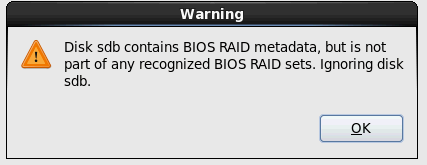
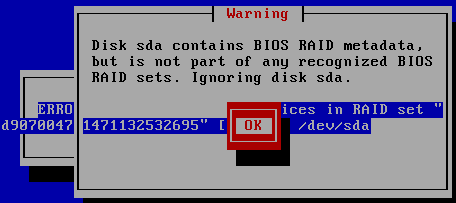
解决办法1:
硬盘显示偶尔/dev/sda,偶尔/dev/sdb。。
从提示看貌似以前该硬盘做过RAID。。但问题是,这是个新的硬盘这样提示。该提示导致系统无法认到硬盘,没法继续安装系统。
后来经过一番Google,安装系统时,输入linux nodmraid就可以继续安装了。。
linux nodmraid命令的意思是关掉阵列。
进入安装选择菜单时
按TAB键,会进入到Linux的命令行模式,然后在启动命令行的后面添加nodmraid(注意前面先加个空格)并按ENTER。
接下进入安装的过程就会发现硬盘找到了。
>vmlinuz initrd=initrd.img nodmraid
要想在后续安装系统时不会出现以上提示,以下是彻底解决方法:
把硬盘放到另外一台机器上
# dmraid -rE /dev/sdb
no raid disks and with names: “/dev/sdb”
不行啊。网上搜索一下,有朋友给出一个更加简单的办法,用parted
网上搜索一下,有朋友给出一个更加简单的办法,用parted
# parted /dev/sdb –script mklabel gpt
# parted /dev/sdb –script — mkpart primary 0 -1
Warning: The resulting partition is not properly aligned for best performance.
# parted /dev/sdb –script print
Model: ATA TOSHIBA MK1002TS (scsi)
Disk /dev/sdb: 1000GB
Sector size (logical/physical): 512B/512B
Partition Table: gpt
Number Start End Size File system Name Flags
1 17.4kB 1000GB 1000GB primary处理完,放回原来的机器,居然就没问题,顺利装完系统。
如果是这样,在急救模式下,运行parted,也是应该没问题。
如果还不行,最后一招就是DD
dd if=/dev/null of=/dev/sda bs=512 count=1
解决办法2(推荐):
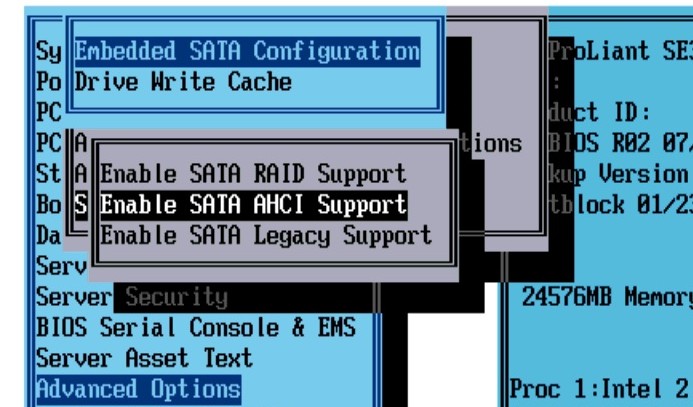
其实多数情况下这种提示我们进入bios下面的 Advanced Options 里按图片选择 这个AHCI 就可以了。
Linux 下用 smartd 监测硬盘状况
和处理器、内存比较,硬盘是服务器上最慢的子系统、是最容易出现性能瓶颈的地方,也是最脆弱的部分。因为硬盘离处理器距离最远而且访问硬盘要涉及到一些机械操作,比如转轴、寻轨等,而机械是容易出故障的。作为 VPS 服务商和系统管理员来说,最害怕的就是硬盘出毛病,所以监测硬盘的健康状况、提前预警是件很重要的事情。我们 PC 服务器上差不多1.5年都会有硬盘坏掉,坏掉前一点征兆都没有,SUN 服务器上的情况要好得到,很多 SATA/SCSI 硬盘运行了5年都没问题,看样子品牌服务器还是贵得有理由的。VPSee 前段时间看过 Google 发表的一篇论文:Failure Trends in a Large Disk Drive Population 也证实了我们的经历,结论是所有坏掉的硬盘中只有60%可以被 S.M.A.R.T. 检测到,也就是说 S.M.A.R.T. 的测试结果只有60%是正确的,所以我们还不能完全依赖 S.M.A.R.T. 的监测结果。
目前市面上所有的硬盘都具有 S.M.A.R.T. (Self-Monitoring, Analysis and Reporting Technology) 特性,smartmontools 就是利用这一特性监测硬盘的软件包,包含 smartctl 和 smartd 两个程序,前者是前台命令行工具、后者是后台运行程序,smartmontools 不是 Linux 的专利,也支持 BSD, Solaris 等系统。
安装 smartmontools
在 CentOS 5.x 下安装:
# yum install kernel-utils
在 CentOS 6.x/Fedora 下安装:
# yum install smartmontools
在 Debian/Ubuntu 下安装:
# apt-get install smartmontools
使用 smartmontools
在使用 smartmontools 测试之前先检查一下硬盘是否具有 SMART 特性:
# smartctl -i /dev/sda
=== START OF INFORMATION SECTION ===
Device Model: SEAGATE ST32500NSSUN250G 0741B58YP8
Serial Number: 5QE58YP8
Firmware Version: 3.AZK
User Capacity: 250,056,000,000 bytes
Device is: Not in smartctl database [for details use: -P showall]
ATA Version is: 7
ATA Standard is: Exact ATA specification draft version not indicated
Local Time is: Thu Jul 22 22:39:07 2010 SAST
SMART support is: Available – device has SMART capability.
SMART support is: Enabled
如果上面 SMART support 是 Disabled 状态的话,需要开启 SMART 的支持:
# smartctl -s on /dev/sda
=== START OF ENABLE/DISABLE COMMANDS SECTION ===
SMART Enabled.
检查硬盘状况,如果下面的结果不是 PASSED 的话你需要立刻警觉起来,马上备份所有数据,硬盘随时都可能出问题(不过值得注意的是就算结果是 PASSED 并不意味着硬盘100%就安全,PASS 不能代表没问题,没 PASS 代表一定有问题):
# smartctl -H /dev/sda
=== START OF READ SMART DATA SECTION ===
SMART overall-health self-assessment test result: PASSED
做个快速自检:
# smartctl -t short /dev/sda
=== START OF OFFLINE IMMEDIATE AND SELF-TEST SECTION ===
Sending command: “Execute SMART Short self-test routine immediately in off-line mode”.
Drive command “Execute SMART Short self-test routine immediately in off-line mode” successful.
Testing has begun.
Please wait 1 minutes for test to complete.
Test will complete after Thu Jul 22 22:51:00 2010
Use smartctl -X to abort test.
执行上面的自检命令后等待一段时间,可以通过下面命令来看进度和结果:
# smartctl -l selftest /dev/sda
=== START OF READ SMART DATA SECTION ===
SMART Self-test log structure revision number 1
Num Test_Description Status Remaining LifeTime(hours) LBA_of_first_error
# 1 Short offline Completed without error 00% 20949 -
# 2 Short offline Completed without error 00% 20947 -
要做长时间自检的话(很耗时,建议放在凌晨时间段做):
# smartctl -t long /dev/sda
查看出错日志:
# smartctl -l error /dev/sda
=== START OF READ SMART DATA SECTION ===
SMART Error Log Version: 1
No Errors Logged
配置 smartmontools
在 CentOS/Fedora 下:
# vi /etc/smartd.conf
# /etc/init.d/smartd restart
在 Debian/Ubuntu 下:
# vi /etc/default/smartmontools
# vi /etc/smartd.conf
# /etc/init.d/smartmontools restart
可以通过修改以上的 smartmontools 的配置文件来定期对硬盘做健康检查,就像给人定期体检一样,体检过了并不代表就没病(很多疾病用体检的设备都查不到),所以这也符合 Google 的硬盘报告所说的情况,所有坏掉的硬盘中只有60%可以被 S.M.A.R.T. 检测到(所有生病的人中只有60%能在体检的时候发现)。
Linux系统中的load average
一、什么是load average?
linux系统中的Load对当前CPU工作量的度量 (WikiPedia: the system load is a measure of the amount of work that a computer system is doing)。也有简单的说是进程队列的长度。
Load Average 就是一段时间 (1 分钟、5分钟、15分钟) 内平均 Load 。
我们可以通过系统命令”w”查看当前load average情况
[root@CNC-BJ-5-3N1 ~]# w
20:01:55 up 76 days, 8:20, 6 users, load average: 1.30, 1.48, 1.69
上面内容显示系统负载为“1.30, 1.48, 1.69”,这3个值是什么意思呢?
第一位1.30:表示最近1分钟平均负载
第二位1.48:表示最近5分钟平均负载
第三位1.69:表示最近15分钟平均负载
PS. linux系统是5秒钟进行一次Load采样
二、load average值的含义
2.1 单核处理器
假设我们的系统是单CPU单内核的,把它比喻成是一条单向马路,把CPU任务比作汽车。当车不多的时候,load <1;当车占满整个马路的时候 load=1;当马路都站满了,而且马路外还堆满了汽车的时候,load>1
Load < 1
Load = 1
Load >1
2.2 多核处理器
我们经常会发现服务器Load > 1但是运行仍然不错,那是因为服务器是多核处理器(Multi-core)。
假设我们服务器CPU是2核,那么将意味我们拥有2条马路,我们的Load = 2时,所有马路都跑满车辆。
Load = 2时马路都跑满了
#查看CPU core
grep ‘model name’ /proc/cpuinfo | wc -l
3. 什么样的Load average值要提高警惕
0.7 < load < 1: 此时是不错的状态,如果进来更多的汽车,你的马路仍然可以应付。
load = 1: 你的马路即将拥堵,而且没有更多的资源额外的任务,赶紧看看发生了什么吧。
load > 5: 非常严重拥堵,我们的马路非常繁忙,每辆车都无法很快的运行
4. 三种Load值,应该看哪个?
通常我们先看15分钟load,如果load很高,再看1分钟和5分钟负载,查看是否有下降趋势。
1分钟负载值 > 1,那么我们不用担心,但是如果15分钟负载都超过1,我们要赶紧看看发生了什么事情。所以我们要根据实际情况查看这三个值。
nginx访问域名自动加端口和nginx访问域名rewrite跳转
需求:nginx规则,所有对OA.vps12.info的访问,redirect到uc.vps12.com
写法:
server
{
listen 80;
server_name uc.vps12.com;
index index.htm index.php;
root /export/home/www
if ($host = “oa.vps12.info”){
rewrite ^/(.*)$ http://uc.vps12.com/$1 permanent;
}
}
如何自动加端口呢?有时我们需要这样的需求:
server {
listen 80;
server_name bbs.vps12.com;
rewrite “^/(.*)$” http://bbs.vps12.com:8066/$1 break;
}
【符号注释】
^ 匹配字符串的开始
/ 匹配域名的分隔符
. 匹配除换行符以外的任意字符
* 重复零次或更多次
(.*) 匹配任意字符
.* 匹配任意文本
$ 匹配字符串的结束
Windows下的PHP安装文件线程安全和非线程安全的区别
从2000年10月20日发布的第一个Windows版的PHP3.0.17开始的都是线程安全的版本,这是由于与Linux/Unix系统是采用 多进程的工作方式不同的是Windows系统是采用多线程的工作方式。如果在IIS下以CGI方式运行PHP会非常慢,这是由于CGI模式是建立在多进程 的基础之上的,而非多线程。一般我们会把PHP配置成以ISAPI的方式来运行,ISAPI是多线程的方式,这样就快多了。但存在一个问题,很多常用的 PHP扩展是以Linux/Unix的多进程思想来开发的,这些扩展在ISAPI的方式运行时就会出错搞垮IIS。而用线程安全版本的话顶多只是搞跨某个 线程,而不会影响到整个IIS的安全。
当然在IIS下CGI模式才是 PHP运行的最安全方式,但CGI模式对于每个HTTP请求都需要重新加载和卸载整个PHP环境,其消耗是巨大的。为了兼顾IIS下PHP的效率和安全, 有人给出了FastCGI的解决方案。FastCGI可以让PHP的进程重复利用而不是每一个新的请求就重开一个进程。同时FastCGI也可以允许几个 进程同时执行。这样既解决了CGI进程模式消耗太大的问题,又利用上了CGI进程模式不存在线程安全问题的优势。
因此,如果是使用ISAPI的方式来运行PHP就必须用Thread Safe(线程安全)的版本;而用FastCGI模式运行PHP的话就没有必要用线程安全检查了,用None Thread Safe(NTS,非线程安全)的版本能够更好的提高效率。
因此,如果是使用ISAPI的方式来运行PHP就必须用Thread Safe(线程安全)的版本;而用FastCGI模式运行PHP的话就没有必要用线程安全检查了,用None Thread Safe(NTS,非线程安全)的版本能够更好的提高效率。
附:德问相关问题摘录
下载PHP安装文件时,我看到有两种不同的二进制文件,像是非线程安全(Non Thread Safe)和线程安全(Thread Safe),比如该页面所列:http://windows.php.net/download/。这个是什么意思,之间有什么区别?
这个主要是针对web server 而言,在windows环境下,如果你使用的web server 是apchae 或者 iis 7以下版本,则应该选择线程安全的安装文件,而如果你使用Fast-cgi模式时,可以选择非线程安全,因为 web sever 本身能保证线程安全。
当然还有二进制文件编译时所使用的编译器:vc9 (vs系列) vc6(gcc)
如楼上所言,是针对web server的,部分web server在处理应用请求的时候是用多线程而非多进程的方式处理,线程方式因为涉及到共享寄存器和内存,所以很容易出错,这个时候程序就需要花一些额外的经历去处理寄存器中的数据一致性,即保证线程安全。
所以是否采用线程安全主要看你的web server所采用的PHP请求处理方式,如果是多线程处理,那么请选择线程安全的,否则选择非线程安全的,如楼上所说Fast-cgi方式可选择非线程安全的
iis7 下动态压缩(gzip压缩)的压缩率更改办法
iis7下默认压缩率是静态压缩: 0, 动态压缩: 7
一般认为: 压缩率9是性价比最好的压缩率
怎么改变默认的压缩率呢? 运行以下命令即可:
%windir%\system32\inetsrv\appcmd.exe set config -section:httpCompression -[name='gzip'].dynamicCompressionLevel:9
%windir%\system32\inetsrv\appcmd.exe set config -section:httpCompression -[name='gzip'].staticCompressionLevel:9
命令运行后, 必须重启IIS, 新的压缩率才开始生效
apache支持下载docx,pptx,rar等文件
apache web服务器的站点,下载pptx,docx,xlsx文件,却被浏览器当作zip文件保存。
这不是浏览器的问题,而是apache不认docx,pptx,,xlsx等Microsoft Office 2007+的文件格式,而这些文件本身是zip压缩文件,所以被apache当作zip压缩文件发给浏览器了。
做个形像一点的比喻:浏览器请求一个url路径,这个路径指向一个.pptx文件,apache从web服务器的目录(磁盘上)查到这个文件,但它不知道这个文件是什么类型(注意:文件类型并不是由文件名后缀决定的,而是文件本身内容所决定),于是它通过分析这个文件内容,发现这个文件像是个zip压缩档,文件大小为12345字节,于是它给浏览器说:“嘿,你请求的是个zip压缩文件,它的大小为12345个字节,文件名是 abcd.pptx 。下面是这个文件的内容,请接收”
浏览器收到消息后,得知apache要发给自己一个zip压缩档,于是一边弹出对话框、询问用户是直接打开、还是保存到硬盘,一边把apache接下来发回的数据保存到缓冲区(或者保存到硬盘的临时目录里),等用户做好选择后,采取相应的打开或是保存的操作。
形象的说明,并不是十分准确的,但大体过程如此。
那现在的问题在于apache因为不认识这个pptx文件,那我们要教会apache,让它知道。我们可以通过mime.types文件让告诉它:
修改mime.types文件,在其中加上
application/vnd.ms-word.document.macroEnabled.12 docm
application/vnd.openxmlformats-officedocument.wordprocessingml.document docx
application/vnd.openxmlformats-officedocument.wordprocessingml.template dotx
application/vnd.ms-powerpoint.template.macroEnabled.12 potm
application/vnd.openxmlformats-officedocument.presentationml.template potx
application/vnd.ms-powerpoint.addin.macroEnabled.12 ppam
application/vnd.ms-powerpoint.slideshow.macroEnabled.12 ppsm
application/vnd.openxmlformats-officedocument.presentationml.slideshow ppsx
application/vnd.ms-powerpoint.presentation.macroEnabled.12 pptm
application/vnd.openxmlformats-officedocument.presentationml.presentation pptx
application/vnd.ms-excel.addin.macroEnabled.12 xlam
application/vnd.ms-excel.sheet.binary.macroEnabled.12 xlsb
application/vnd.ms-excel.sheet.macroEnabled.12 xlsm
application/vnd.openxmlformats-officedocument.spreadsheetml.sheet xlsx
application/vnd.ms-excel.template.macroEnabled.12 xltm
application/vnd.openxmlformats-officedocument.spreadsheetml.template xltx
这样的一部分代码,这里包含了ms office相关的很多文件类型。
mime.types文件位置
那mime.types文件在什么位置呢?
对于windows版本的apache,它在apache安装目录下的conf子目录里,典型位置为 X:\Program Files\Apache Group\Apache2\conf\mime.types
而linux版本下,通常位于/etc/mime.types, 如redhat/centos/fedora都是如此,debian/ubuntu系列应该也在这里,个人没有亲自查证。
不过centos并不推荐在这里修改,参看这里 http://www.centos.org/docs/5/html/Deployment_Guide-en-US/s1-apache-config.html TypesConfig一小节
Instead of editing /etc/mime.types, the recommended way to add MIME type mappings is to use the AddType directive.
建议不要去修改 /etc/mime.types ,添加MIME type的推荐方法是使用apache的 AddType 指令.
AddType application/vnd.ms-word.document.macroEnabled.12 docm
AddType application/vnd.openxmlformats-officedocument.wordprocessingml.document docx
AddType application/vnd.openxmlformats-officedocument.wordprocessingml.template dotx
AddType application/vnd.ms-powerpoint.template.macroEnabled.12 potm
AddType application/vnd.openxmlformats-officedocument.presentationml.template potx
AddType application/vnd.ms-powerpoint.addin.macroEnabled.12 ppam
AddType application/vnd.ms-powerpoint.slideshow.macroEnabled.12 ppsm
AddType application/vnd.openxmlformats-officedocument.presentationml.slideshow ppsx
AddType application/vnd.ms-powerpoint.presentation.macroEnabled.12 pptm
AddType application/vnd.openxmlformats-officedocument.presentationml.presentation pptx
AddType application/vnd.ms-excel.addin.macroEnabled.12 xlam
AddType application/vnd.ms-excel.sheet.binary.macroEnabled.12 xlsb
AddType application/vnd.ms-excel.sheet.macroEnabled.12 xlsm
AddType application/vnd.openxmlformats-officedocument.spreadsheetml.sheet xlsx
AddType application/vnd.ms-excel.template.macroEnabled.12 xltm
AddType application/vnd.openxmlformats-officedocument.spreadsheetml.template xltx
可以把这些指令加到apache的配置文件里,该指令在apache里出现过N次,不需多说,照着加进去就对了。
rar怎么支持呢?其实也很容易。找一下zip然后在zip支持下加一条一样的。把zip改成rar重启apache就可以了。
